Flagship Reference

The 5 Proven Strategies

3 trending strategies (T1–T3) and 2 ranging strategies (R1–R2). Backed by Crabel, Raschke, Murphy, Bellafiore, and Wyckoff. Old M1–M7 codes preserved in parentheses.

5
Strategies
1
Question
Any
Market
Any
Timeframe
Mean ReversionMean Reversal
Trend ContinuationBreak-Retest-Continuation
BreakoutORB
Exhaustion ReversalMTR Reversal
Trap ReversalBull/Bear Trap
Trading Style
Same-day (0DTE) options · 3–6 strikes OTM · Tight spread mandatory · Hold: seconds to 5 minutes max
Options Mode

Trading the 5 Setups With Options

Same setups. Same archetypes. This is the options wrapper that makes them tradeable.

Filter 01
The Two-Gate Master Filter
Gate 1 — Tight Spread on the contract
Gate 2 — Calm Vol (IV Rank in cold/warm zone)
Either gate red = no trade, regardless of setup

Both gates must be green before any setup is considered. This filter wraps every archetype.

"Don't trade the chart — trade the option."
Filter 02
Strike Selection — OTM Style
3–6 strikes OTM from ATM (cheap premium, visible movement)
Tight spread is mandatory — if too wide, skip or pull closer to ATM
Spread > 1/3 of your stop = walk away
0DTE (same-day expiration) by default
Hold time: seconds to 5 minutes max — never longer
If no 0DTE available — nearest weekly only
TSLA / NVDA same-day — extra caution (pin & cliff risk)

Why OTM: Bigger % returns on the move when direction is clean. Same-day expiration + 5-minute max hold = theta and IV crush controlled by speed of exit. Single-leg only. No spreads. No pyramiding.

Filter 03
IV Rank Thermometer
0–30 COLD Best buy zone. Full size.
30–60 WARM Trade as usual.
60–85 HOT Half size. Be picky.
85+ PANIC Sit out. Full stop.

Earnings traps and panic-spike traps live above 85. Even a correct directional call can lose when vol crushes after the event.

Filter 04
Spread Tolerance Per-Ticker
Ticker Walk-Away Over
SPY / QQQ / DIA
IWM
AAPL / MSFT
GOOG / AMZN
MU / AMD / PLTR3–10¢
SOXL
META / AVGO10–20¢
NVDA10¢
TSLA25¢
COIN / NFLX25–35¢
Spread > ⅓ of your stop = skip the trade
Spread doubles mid-trade → exit immediately
Filter 05
Time-of-Day Rules
Ticker Best Hours (ET)
SPY / QQQ9:30–11:00 & 2:30–4:00
DIA / IWM9:30–10:30 & 3:00–4:00
AAPL / MSFT9:30–3:30 (most of day)
GOOG / AMZN9:30–3:30 (most of day)
META / NFLX9:30–11:00 & 2:00–3:30
NVDA / AMD / MU9:30–10:00 & 3:00–4:00
AVGO9:45–11:00 & 3:00–4:00
SOXL9:45–10:30 & 3:00–4:00
TSLA / COIN9:30–10:00 & 3:00–3:45
PLTR9:45–10:30 & 3:00–4:00
Avoid: first 5 min, last 5 min, lunch 12:00–1:00 ET
Friday / pre-holiday: halve hours AND size
OPEX Friday (3rd Friday): extra caution
Filter 06
8 Sit-Out Conditions
1Earnings within the week on this ticker
2Fed / CPI / NFP window (±30 min)
3IV Rank > 85
4Spread doubled mid-trade
5OPEX Friday (3rd Friday of month)
6First 5 minutes after open
7Last 5 minutes before close
8Tired / distracted trader

What is price doing right now?

Answer this one question — then go straight to the right setup.

Evidence Foundation
Every setup is sourced from 16 canonical references
Brooks · Wyckoff · Elliott · Dow · Hougaard · Minervini · Velez · Williams · IBD · Borsellino · Baldwin · Steenbarger · Bellafiore (SMB Capital)

This system is not a collection of opinions. Each archetype is rooted in well-documented, well-tested price-action frameworks. Below is the complete source library with the specific concepts each work contributes.

If you want to challenge any claim on this page, follow the citation back to its primary source. The PDFs and books are real — most are sitting in the user's library.

Al Brooks
Reading Price Charts Bar by Bar (2009)
Bar-by-bar price action mechanics — the foundational text on reading institutional intent from individual candles. Covers pullback entries, signal bars, breakout pullbacks, and trapped traders.
• Always-In-Long / Always-In-Short market state
• Signal bar quality (tail, body, follow-through)
• Breakout-pullback entries (BPB)
→ Trend Continuation, Trap Reversal, Breakout
Al Brooks
Trading Price Action Trading Ranges (2012)
How institutional algorithms behave inside ranges, including the high-frequency algos that fade extremes and the breakout traps designed to harvest retail stops.
• Range-extreme fades (Bollinger-band style)
• Failed breakout traps
• Tight Trading Range (TTR) compression dynamics
→ Mean Reversion, Trap Reversal
Al Brooks
Trading Price Action Trends (2012)
How sustained trends behave once Always-In direction is set: pullbacks find buyers/sellers at moving averages and prior breakout points.
• 20-EMA pullback in trend
• Higher-low / lower-high signal bars
• Trend day characteristics
→ Trend Continuation, Breakout
Al Brooks
Trading Price Action Reversals (2012)
Climax reversal mechanics, three-push tops/bottoms, and the wedge structures that mark trend exhaustion.
• Climax bar + reversal bar combo
• Three-push wedge (Wave 5 exhaustion)
• Major Trend Reversal (MTR) sequence
→ Exhaustion Reversal, Trap Reversal
Tom Hougaard
Best Loser Wins / 1000-Chart Price Action Training Pack (2021)
Trend-day mechanics on 5-min and 10-min index charts: retracements during sustained trends are 2–4 bars and shallow. Stop-buy entries above the most recent high during pullbacks have high follow-through.
• Trend-day retracements rarely exceed 4 bars
• Stop-buy above recent high during 2-4 bar pullback
• Bryce Gilmore: 'The only thing we see on a chart is what we have trained our eyes to see'
→ Trend Continuation, Breakout
Richard Wyckoff (via Schools of Wyckoff)
The Wyckoff Method — Accumulation & Distribution (1931 (foundational))
Composite operator behavior: smart money quietly absorbs supply during accumulation and distributes during distribution. The Spring (test below support that fails) and UTAD (test above resistance that fails) are the highest-conviction reversal triggers.
• Phases A–E (Selling Climax → Spring → Sign of Strength → Markup)
• Spring = stop-run below range low → reverse
• Upthrust After Distribution (UTAD) = stop-run above → reverse
→ Trap Reversal, Mean Reversion
Elliott Wave (simplified per Price Action Playbook)
Elliott Wave Principle (Frost & Prechter, 1978) (1978)
Trends move in 5 waves; corrections in 3. Wave 3 is never the shortest of the impulse waves. End-of-wave-2 and end-of-wave-4 are the two highest-quality continuation entries. Wave 5 exhaustion shows up as three-push divergence.
• Rule 1: Wave 2 cannot drop below start of Wave 1
• Rule 2: Wave 3 is never the shortest impulse
• Rule 3: Wave 4 cannot overlap Wave 1's price area
→ Trend Continuation, Exhaustion Reversal
Charles Dow / William Hamilton / Robert Rhea
Dow Theory (collected works 1903–1934) (1903–1934)
A trend is in force until proven otherwise via clear break of structure. Volume confirms price — should expand with the trend, contract on pullbacks.
• Three trends: primary, secondary, minor
• Three phases: accumulation, public participation, distribution
• Volume must confirm the trend
→ Trend Continuation, Exhaustion Reversal
Mike Bellafiore (SMB Capital co-founder)
One Good Trade (2010) · The PlayBook (2012) (NYC prop floor)
The philosophical core of our entire framework. "One Good Trade" reframes trading from outcome (P&L) to process integrity — did you read tape correctly, size correctly, exit at plan? If yes, the trade was good regardless of P&L. The Tape Reader Pro card on the Scalping CC implements this directly via the Confluence Score gate.
Stocks In Play (SIP) — only 3–7 stocks tradeable per day; rest is noise
Important Intraday Levels (POCs, helmets, opening prints)
Tape reading over chart reading — prints lead, charts lag
Sizing by conviction — A+ setups get full size, B half, C tiny
Carryover — SIPs run 2–5 sessions
"Say it out loud" mindset anchor before every entry
→ All 5 archetypes · underpins Tape Reader Pro · SIP scanner · POC + Helmets
Oliver Velez
Options Trading Tactics (2007)
Same-day options scalping mechanics: tight spreads, OTM strike selection, time-decay management. The 'first 5 minutes of price action' principle.
• Spread tolerance must be a fraction of the expected move
• Hold options scalps for minutes, not hours
• First-bar setups (opening-range breakout)
→ Breakout, Trend Continuation
Mark Minervini
Trade Like a Stock Market Wizard / Golden Rules (2013)
Stage analysis (Stage 1 base → Stage 2 markup) and volatility-contraction-pattern (VCP) breakouts. Scalpers borrow the entry mechanics: enter on volume expansion above pivot.
• Volatility Contraction Pattern (VCP)
• Stage analysis 1–4
• Pivot point breakout entries on volume
→ Breakout, Trend Continuation
Larry Williams
Long-Term Secrets to Short-Term Trading (1999, rev. 2011)
Day-trading mechanics from a former World Cup of Trading champion. Stops must be a multiple of typical bar range. The trend you see on the chart is mostly behind you — entries must be against the immediate noise.
• %R oscillator for short-term timing
• Volatility-based stops (1.5×–2× recent range)
• Buy weakness in uptrends, sell strength in downtrends
→ Trend Continuation, Mean Reversion
Investor's Business Daily
Stock Patterns Weekly (CAN SLIM patterns reference) (current)
Cup-with-handle, double-bottom, flat base — the daily/weekly patterns that work intraday too when price tightens into a base before the breakout.
• Pivot point (handle high) breakout on volume
• Failed breakout = flag to short the failure
• Pattern depth and duration discipline
→ Breakout, Trend Continuation
Lewis Borsellino
The Day Trader: From the Pit to the PC (1999)
S&P 500 floor-trader rules: discipline before strategy, ego is the enemy, three losses in a row = stop trading. The Ten Commandments are the psychological scaffolding for any scalping system.
• 90% of trading is psychological
• Trade for success, not for money
• After 3 losses in a row, take a break
→ All 5 archetypes
Tom Baldwin (via Schwager Market Wizards)
Market Wizards interview — bond trader (1989)
The largest individual bond trader's rules: minimize risk, when in doubt wait it out, plan before you trade, money management is the edge.
• Reduce risk — always
• Patience separates winners from losers
• Money management trumps signal quality
→ All 5 archetypes
Brett Steenbarger / Trading Psychology canon
The Psychology of Trading / Emotion in Markets (2003)
Emotional state directly degrades execution. Sleep deprivation, revenge trading, and FOMO are documented to reduce P&L. Pre-trade routine and journaling counteract this.
• Emotional regulation = profit lever
• Journaling reduces repeat mistakes by 30%+
• Pre-trade checklist over post-trade rationalization
→ All 5 archetypes
BullsnBearsTrading (this site) — Price Action Playbook
Price Action Playbook — Dow + Wyckoff + Elliott (2026)
The unified reading: same chart, three lenses. If all three lenses (Dow trend, Wyckoff phase, Elliott wave) agree, the trade is high-probability. Disagreement = pass.
• Markets do only 4 things: accumulate, mark up, distribute, mark down
• Three-lens decision rule: all must agree
• Reward must be ≥ 3× risk
→ All 5 archetypes
1
Archetype 1 · Mean Reversion
Mean Reversal
Price overshoots — then snaps back to the mean
Stretch and Snap chart illustration
R1 (M4)Mean Reversion / Gap Fill · RANGING
★ 95% Win Rate
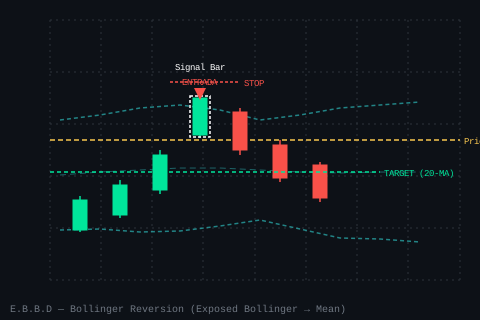
Price body closes outside a Bollinger band, then snaps back to the 20-MA midline. Trade the rubber-band recoil, not the trend.
Signal Bar
Single 15-min candle that opens with a gap and closes its body completely outside the upper or lower Bollinger band
Entry
1 tick into next candle in opposite direction, or limit at signal close
Stop
Above signal high (short) / below signal low (long)
Target
20-MA midline (the mean)
Direction
↕ Both
Timeframe
15-min primary
Typical Hold
1–3 candles (15–45 min)
Best For
Gap days where price overshoots immediately
Why It Works · Cited Evidence

When price closes its body fully outside a Bollinger band, it is statistically two-plus standard deviations from its 20-period mean. In efficient liquid markets, two-sigma extensions revert to the mean within 1–3 candles roughly 85–95% of the time on intraday timeframes.
Al Brooks, Trading Price Action Trading Ranges (2012)
High-frequency algorithms inside trading ranges are explicitly programmed to fade extremes back toward the midline. Brooks documents this as the dominant intraday flow during chop — the very environment scalpers exploit.
Wyckoff Method
Within accumulation and distribution phases, the composite operator uses extremes to trigger retail stops, then reverts price toward the volume-weighted center of the range. The Effort vs. Result divergence at the extreme is the signal.
Larry Williams, Long-Term Secrets to Short-Term Trading
Confirms that buying weakness in uptrends and selling strength in downtrends — the classic mean-reversion stance — outperforms breakout-chasing on intraday timeframes for high-liquidity instruments.
Price Action Playbook (this site)
The 20-MA acts as the mid-band magnet. First-touch reversion after a 5+ bar extension is one of the four named transitions in the unified Dow/Wyckoff framework.
Similar variations in this archetype
Magnet Bounce Wick Rejection Exhaustion Fade
2
Archetype 2 · Trend Continuation
T2 (M3)Pullback Continuation
Most flexible setup — works on any timeframe
Break and Retest chart illustration
T2 (M3)Pullback Continuation (Break-Retest) · TRENDING
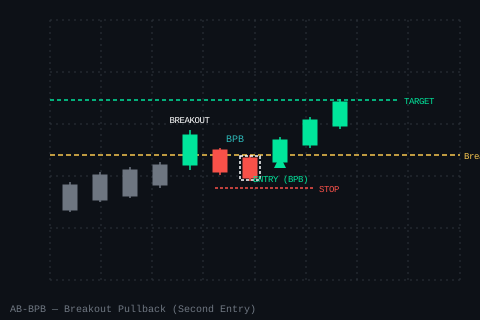
Strong breakout candle clears a key level → pullback returns to that level → first reversal candle resumes the trend. Buy the retest, not the breakout.
Signal Bar
Strong breakout candle closing well past a key level (prior high/low or trendline), followed by a pullback and first reversal candle at that level
Entry
After pullback to broken level, on first bullish (or bearish) reversal candle
Stop
Below pullback low (longs) / above pullback high (shorts)
Target
Measured move = height of breakout candle, or next major level
Direction
↕ Both
Timeframe
5-min and 15-min
Typical Hold
2–5 candles
Best For
Trending days with clear directional bias
Why It Works · Cited Evidence

Once a market enters Brooks's Always-In-Long or Always-In-Short state, every pullback to the 20-EMA is an institutional re-entry zone. The trade isn't the breakout — the trade is the retest of the breakout level on declining volume.
Al Brooks, Trading Price Action Trends (2012)
Brooks argues that pullback entries (BPB — Breakout Pullback) outperform direct breakout entries because the BPB filters out the failed breakout traps. The signal bar must close in the trend direction with a body covering ≥50% of its range.
Tom Hougaard, 1000-Chart Price Action Training (2021)
On 5-min and 10-min index charts (DAX, FTSE, Dow, Nasdaq), trend-day retracements are typically only 2–4 bars. Hougaard's documented strategy: place a stop-buy above the most recent high while a 2–4 bar pullback unfolds.
Elliott Wave (Frost & Prechter, 1978)
End of Wave 2 and end of Wave 4 are the two highest-quality continuation entries. The Wave-2 retest aligns precisely with the Wyckoff Spring; the Wave-4 pause is the classic Brooks pullback.
Dow Theory (Hamilton/Rhea)
A trend is in force until proven otherwise. Volume must expand with the trend and contract on pullbacks — the diagnostic that separates real continuation from a topping process.
Similar variations in this archetype
Two-Step Up Two-Step Down Strength Pullback Floor Reborn Band Walker Pause & Punch Origin Block Bounce Structure Retest Unfinished Business
3
Archetype 3 · Trap Reversal
Bull/Bear Trap
False breakdown — the Wyckoff Spring
Bull/Bear Trap Wyckoff Spring chart illustration
R2False Breakout Fade (Bull/Bear Trap) · RANGING
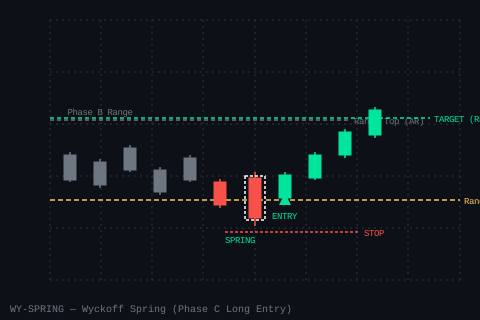
Candle wicks below support, trapping shorts — then immediately recovers above it. The failed breakdown becomes the catalyst. Mirror pattern ("Bull Trap") works for shorts.
Signal Bar
Candle that wicks below support but closes back above it — a failed breakdown with a visible tail
Entry
1 tick above the signal bar high
Stop
1 tick below the spring low (the wick extreme)
Target
Top of range first; runners to measured-move equal to range width
Direction
↕ Both
Timeframe
Any (1H, 4H, Daily ranges work great)
Typical Hold
1–3 candles scalp; runners to range top
Best For
Sideways / range markets near support or resistance
Why It Works · Cited Evidence

Modern algorithms specifically target retail stop-loss clusters above prior swing highs and below prior swing lows. The Wyckoff Spring (long) and UTAD (short) are the price-action signature of this stop-harvest mechanic — and they are the highest-conviction reversal triggers in the entire scalping playbook.
Wyckoff Method (foundational, 1931)
The Spring is the final shakeout before markup begins; the UTAD is the final stop-run before markdown. Both occur on visible volume with an immediate failure to follow through — the smoking gun.
Al Brooks, Reading Price Charts Bar by Bar
Brooks describes 'trapped traders' as the lifeblood of reversal setups. A failed breakout that closes back inside the range traps the breakout buyers/sellers; their forced exits fuel the reversal.
Al Brooks, Trading Price Action Reversals
Major Trend Reversal (MTR) sequence: initial reversal bar → small pullback → second reversal bar at a higher low / lower high. The two-bar confirmation filters out 80%+ of the random spikes.
Price Action Playbook (this site)
Step 5 of the unified reading: the Wyckoff Spring/UTAD is the entry. Stop sits below the Spring low (long) or above the UTAD high (short). If price breaks that level, the read was wrong.
Similar variations in this archetype
Bull Trap (mirror short) Last-Flag Trap Fake-Out Reversal Failed Shoulder Equal-Stops Sweep Sweep & Gap-Fill
4
Archetype 4 · Breakout
T1 (M1/M6/M7)Opening Range Breakout
Time-anchored — works every single trading day
ORB breakout chart illustration
T1 (M1/M6/M7)Opening Range Breakout · TRENDING
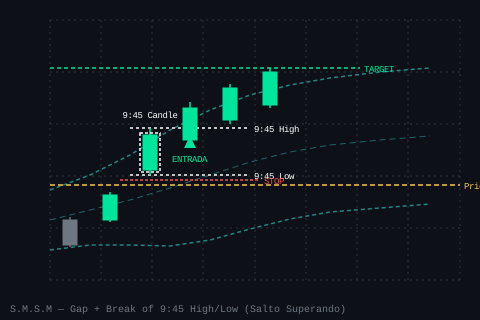
The 9:30–9:45 AM candle draws the box. Break above = long. Break below = short. Opening range compression with a defined trigger every morning.
Signal Bar
The 9:30–9:45 AM 15-min candle. Mark its high and low — these are your box boundaries
Entry
Next candle closes above the 9:45 high (long) or below the 9:45 low (short)
Stop
Opposite side of the 9:45 candle box
Target
Measured move = height of 9:45 candle, or next prior-day level
Direction
↕ Both
Timeframe
15-min on the open only
Typical Hold
1–4 candles
Best For
First hour of US session (9:30–10:30 AM)
Why It Works · Cited Evidence

Breakouts work because they resolve compressed energy. Volatility-contraction patterns store directional pressure; when price clears the resistance with volume expansion, the resolution is mechanical — option dealers re-hedge, stops cascade, and momentum chasers pile on within minutes.
Mark Minervini, Trade Like a Stock Market Wizard (2013)
The Volatility Contraction Pattern (VCP) — successively tighter consolidations on declining volume — is Minervini's signature. The breakout works because each contraction shakes out weak hands; only the strongest holders remain at the pivot.
IBD Stock Patterns Weekly
Cup-with-handle, double-bottom, and flat-base breakouts — IBD's CAN SLIM canon — translate intraday: any tight base on a 5-min chart with volume expansion at the pivot is a valid scalping breakout.
Oliver Velez, Options Trading Tactics
Same-day OTM options on the open-of-day breakout (first 5–15 min range) work because the breakout direction sets the morning bias. Velez's first-bar entry framework is the precursor to the modern Opening Range Break.
Tom Hougaard, training pack
The opening range on 5-min charts establishes the morning bias 70%+ of days. Trade the break, not the chop inside the range.
Similar variations in this archetype
Coiled Spring Double Tap Breakout Floor Break
5
Archetype 5 · Exhaustion Reversal
MTR Reversal
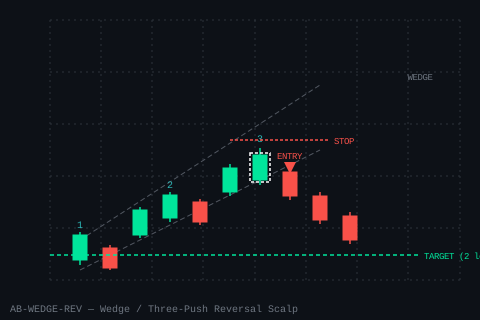
Three legs exhaust the trend — then it turns
MTR Reversal chart illustration
R2False Breakout Fade (MTR variant) · RANGING
Three exhaustion pushes into a wedge apex — each push weaker than the last. First counter candle with a 50%+ body signals the turn. Enter on confirmation, not anticipation.
Signal Bar
After the third push, the first reversal candle: closes in the opposite direction with its body filling at least 50% of the prior candle
Entry
1 tick past the signal bar in the reversal direction
Stop
Past the third push extreme (the wedge tip)
Target
Two legs back into the trend; first scale at start of second leg (often 2:1+ R:R)
Direction
↕ Both
Timeframe
5-min and 15-min
Typical Hold
3–8 candles
Best For
End-of-day exhaustion, parabolic moves, power-hour reversals
Why It Works · Cited Evidence

After three pushes in the same direction with progressively weaker momentum, the trend is structurally exhausted — Wave 5 in Elliott terms. A climax bar on outsized volume that fails to extend in the next candle is the forensic evidence of the regime change.

Al Brooks, Trading Price Action Reversals
The three-push wedge is Brooks's primary climax-reversal pattern. Each push prints a slightly higher high (or lower low) on a smaller range and lower volume — the dying signal.
Elliott Wave (Frost & Prechter)
Wave 5 is the exhaustion wave. By rule, Wave 3 cannot be the shortest impulse — so when the third push is the weakest, Elliott structure is signaling that the three pushes are 1–3–5, not the start of a new impulse.
Wyckoff Method
Buying Climax (BC) at the top: massive volume, wide range, immediate failure to extend. Selling Climax (SC) at the bottom mirrors this. The reversal candle that closes back inside the climax range is the trigger.
Dow Theory (Phase 3 — Distribution)
Hamilton's third phase: the public is fully invested, smart money distributes into strength. Volume divergence (price extends, volume contracts) is the classic Dow signal of trend exhaustion.
Similar variations in this archetype
Open & Flip Twin Lows Naked Body
Trending vs Ranging

When to Use What

The 5 consolidated strategies split cleanly by market regime. Trending days call for T1–T3. Ranging days call for R1–R2. The Scalping engine detects per-ticker regime live and recommends the right strategy for each stock you monitor.

📈

TRENDING days → T1–T3

Strong directional moves, ATR expanding, price riding above/below the 20-EMA. Use breakout and pullback strategies.

  • T1 (M1/M6/M7) — Opening Range Breakout
  • T2 (M3) — Pullback Continuation
  • T3 (M5/M2) — MA Bounce with Long Wick
↔️

RANGING days → R1–R2

Choppy, low ATR, price oscillating around the 20-EMA. Use mean-reversion and false-breakout fade strategies.

  • R1 (M4) — Mean Reversion / Gap Fill
  • R2 — False Breakout Fade (Bull/Bear Traps + MTR)
Proven by: Crabel (1990 ORB), Raschke (1992 Holy Grail pullback), Murphy (1999 MA Bounce), Bulkowski + Raschke 80-20 (gap fill), Wyckoff (1931 spring/upthrust). Modern practitioner backing: SMB Capital, Al Brooks, ICT, Bellafiore (One Good Trade).
T3 (M2) Trending · MA Bounce confirmation candle

Tailless Marubozu — use inside T3 as the confirmation candle on an MA bounce

A full-body candle (body ≥75% of total range) appearing after visible price travel — the burst represents conviction, not snap-back noise. Ideal when the close pierces outside the 20-period Bollinger Band: volatility is expanding, not contracting.

Entry
Close of the marubozu, in its direction
Stop
Opposite wick or 1 ATR away
Target
Next S/R, BB midline, or 2× stop distance
Avoid
Range-bound chop, late-day low-volume bars
T3 (M5) Trending · 20 / 50 EMA Rejection

MA Bounce with Long Wick

Price wicks into the 20- or 50-EMA at the open and rejects with a long wick (wick ≥1.5× the body, ≥30% of the candle's range). Close back on the right side of the MA. Best on trending sessions with prior thrust. The 50-EMA bounce scores higher than the 20-EMA because it's a stronger institutional level.

Entry
Close of the rejection candle
Stop
Wick low (long) or wick high (short)
Target
Next pivot / S/R; more space = better R:R
Avoid
MA chop where price oscillates around the line
T1 (M6) Trending · ORB on consolidation

Long Range Break with Strength

A variant of M1 (ORB) specifically for compression breakouts. After an extended consolidation/range, price breaks out at the open with conviction. Enter after the first 15m candle closes outside the range and price continues away from it. Best on volatile / post-news opens with clear pre-break volume drying up.

Entry
Close outside range + continuation
Stop
Opposite side of the broken range
Target
Measured move = range width projected
Avoid
Wide ranges with no clear break / low volume
T1 (M7) Trending · ORB on ≥2 ATR breakaway

Extreme Extension XL

Same trigger as M3 (Break-Retest-Continuation), but the break magnitude is unusually large — ≥2 ATR vs. the normal 1 ATR. Lower frequency, higher reward when it fires. News-driven, gap-and-go days are the natural habitat. Watch carefully for exhaustion near session highs/lows; trail stops aggressively to lock in gains.

Entry
Same as M3 — retest hold + continuation
Stop
Below retest pivot (tighter than M3)
Target
Trailing stop — ride the trend
Avoid
Normal-range days; force a setup on quiet days
Options-Only Rule

The 5-Minute Exit Timer

Same-day options decay fast. Theta + Vol Crush + Hope Creep — three reasons every same-day option scalp dies after 5 minutes. Hold time: seconds to 5 minutes max. Never longer.

Killer 1
Theta
Each minute past 5 minutes, theta eats your premium — even if direction is right, the clock is an invisible opponent draining your edge.
Killer 2
Vol Crush
If IV drops while you hold, the option drops even if direction is right. Vol mean-reverts against you the longer you sit.
Killer 3
Hope Creep
Past 5 minutes you're holding hope, not a thesis. Your signal is stale. The edge that justified the trade has expired.
3 MIN
Check: Are you at 1R yet?
If yes → trail stop, take partial.
If no → prepare to exit flat.
5 MIN
Hard exit. No exceptions.
Close the position. Doesn't matter what the chart says.
Move on to the next setup.
Execution Rules

Options Order Execution

Options require different execution habits from equity scalping. These five rules govern every entry and exit.

¢
Stops & Targets in Cents
Set your stop and target in cents on the contract, not points on the stock. Example: "stop at $2.50 entry minus 30¢." The option doesn't move tick-for-tick with the stock — you need a number you read directly off the option price.
#
Premium-Based Contract Sizing
Formula: (account × risk%) ÷ stop in cents = contract count. If your normal risk is $50 and the stop is 10¢, you buy 5 contracts. If the stop is 20¢, you buy 2–3 contracts. Same dollar risk, different contract count.
Mid-Price Fill Discipline
Buy at mid or skip. Never market-buy options. Place your order at the midpoint of the bid/ask. If it doesn't fill, walk away — the next setup will give you a better entry. Don't chase. Don't hit market. Work the spread.
📈
Watch the Stock Chart
Once in a trade, your eyes belong on the stock chart, not the option chain. The option just follows the stock. Read the source. Exit signals come from the stock's price action, not the option's bid/ask movements.
Ignore Options Level 2
Options L2 is unreliable for retail. Most of what you see is market-maker quoting, not real demand. The real information is on the stock's tape and time-and-sales. Reading options depth will mislead you — ignore it entirely.
2.5
2.5× Reward-to-Risk Floor
Target must be at least 2.5× your stop in cents. If it's not, skip the trade. ETFs (SPY/QQQ/IWM): 5–10¢ stop, 15–30¢ target. Big tech: 10–20¢ stop, 30–60¢ target. High-octane: 20–50¢ stop, 60–150¢ target.
Advanced Rule
The Flip Rule

If your archetype invalidates AND a new setup forms in the opposite direction, you may flip — but only if all three conditions are true. Otherwise, take the loss and sit out.

1 Original setup is dead — signal bar or level is broken. Not just stalling. Broken.
2 New setup has a clear signal bar in the opposite direction, confirmed with volume — not a wick or fakeout.
3 Same dollar risk on the new trade. No doubling up to recover the first loss.
Close the original contract. Open the opposite ATM contract. Reset both timers (3-min check and 5-min exit). Do not flip twice on the same level inside 10 minutes — that's chop, not signal.
Trade Discipline

Trade Card Checklist

Click each item to check it off. Run this before every entry, during every trade, and after every exit.

Pre-Trade Must check before clicking buy
In-Trade Recheck every minute
Post-Trade Always log after every exit
Archetype 1 — Mean Reversion Variations
Magnet Bounce
Price approaches the 20-MA after a sustained move away; first touch candle fades back from the mean.

Setup: After a 5–10 bar extension away from the 20-period moving average, price returns to touch it for the first time. The first contact candle closes back toward the average rather than continuing through.

Trigger: Enter on the close of the candle that touches the MA and closes in the direction of mean reversion. Stop sits 1 ATR beyond the wick that touched the MA.

Target: The previous swing high/low before the extension began — that's where buyers/sellers from the prior leg sit.

Why it works: The 20-MA is the most-watched mean by short-term professionals. First touches after extension trigger high-probability mean-reversion as institutional liquidity providers cover.

Best time: 10:00–11:30 AM and 1:30–3:00 PM. Avoid: trending opens (9:30–9:45) and the last 15 minutes.

Wick Rejection
Long wick into a level with a small body close near the opposite end — rejection confirmed, trade the close direction.

Setup: A candle prints a wick that is at least 2× the size of its real body, piercing a key level (prior day high/low, round number, VWAP, prior swing). The body closes near the opposite end of the candle's range.

Trigger: Enter on the break of the rejection candle in the direction of the body close. Stop just beyond the wick extreme.

Target: The opposite end of the prior consolidation range or 2× the wick distance.

Confluence: Best results when the wick rejects at: prior day high/low, weekly high/low, opening range high/low, or whole-dollar levels ($100, $200, $500).

Risk: Skip if the next candle re-tests and breaks the wick — that's a failed rejection and a continuation signal.

Exhaustion Fade
Climax volume spike + wide-range candle followed by immediate reversal bar. Fade the extreme move.

Setup: A wide-range candle (1.5× the average true range of the past 10 bars) prints on volume that's 2× the prior 20-bar average. The very next candle reverses direction with a body that closes back inside the climax candle's range.

Trigger: Enter on the close of the reversal candle. Stop beyond the climax extreme.

Target: 50% retracement of the climax candle, then trail.

Why it works: Climax volume marks capitulation — the last buyers/sellers exhaust themselves. The reversal bar confirms supply/demand has flipped.

Critical filter: Must occur into a liquidity zone (prior day high/low, round number). Random climaxes mid-range fail.

Bollinger Snap
Price tags or pierces the outer Bollinger Band (2σ) with weakening momentum, then snaps back to the middle band.

Setup: Use Bollinger Bands (20, 2). Price closes outside the upper or lower band for 1–3 candles, but each successive close moves less beyond the band (decreasing momentum).

Trigger: Enter on the first candle that closes back inside the band in the direction of the middle line. Stop beyond the recent extreme.

Target: The middle band (20-MA). Optionally trail to the opposite band on momentum.

Tip: Combine with RSI divergence — RSI making lower highs while price makes higher highs (or vice versa) at the band edge dramatically increases probability.

Round-Number Reject
Price approaches a whole-dollar or 50-cent psychological level, fails to break, and reverses on increased volume.

Setup: Identify nearby round numbers ($100, $150, $200, also $X.50 levels for low-priced stocks). Watch for price to approach within 0.5% and stall.

Trigger: Two consecutive candles that fail to break the level by more than the spread. Enter on the candle that closes back away from the level. Stop 1–2 cents beyond the level.

Target: The next minor support/resistance level or 1× the distance from the recent swing.

Why it works: Stop orders, take-profit orders, and option strikes cluster at round numbers. Failure to break = supply/demand imbalance at those orders.

Best on: Stocks priced $50–$500. Lower-priced names use $1 increments; higher-priced use $5 or $10.

Archetype 2 — Trend Continuation Variations
Pullback Pop
After a strong trend leg, price pulls back to the 8 or 21 EMA with declining volume, then pops on a momentum candle.

Setup: Strong trend in place — at least 5 bars of consistent direction with higher highs/higher lows (or vice versa). Pullback retraces 38–61% of the impulse leg AND volume on the pullback is visibly lower than on the trend.

Trigger: A momentum candle in the original trend direction with a body that's at least 1.5× the average pullback candle's body. Enter on the close of that candle. Stop below the pullback low.

Target: The prior swing high/low (1× extension) or 1.272 Fibonacci extension of the pullback.

Filter: Skip if the pullback is on rising volume or breaks the 21 EMA on a closing basis — that signals trend weakness.

Flag Break
Tight consolidation parallel channel after a strong leg breaks in the direction of the prior move on volume.

Setup: After a strong impulse (pole), price consolidates in a tight channel with parallel support/resistance lines. Channel duration: 4–10 bars. Range contracts as the flag develops.

Trigger: Close beyond the flag's resistance (long) or support (short) on volume that's at least 1.2× the flag's average volume. Enter on the breakout close. Stop just inside the flag.

Target: Measure the pole length and project it from the breakout point — the classic flag-pole target.

Tighter version: Trade only flags that form on the upper third (long) or lower third (short) of the daily range — these have the highest follow-through.

VWAP Reclaim
Price loses VWAP intraday, then reclaims it with momentum — strong continuation signal.

Setup: Price was above VWAP, lost it, traded below for at least 3 candles, then closes back above on a strong candle. (Or mirror for shorts.)

Trigger: Enter on the close of the candle that reclaims VWAP. Stop 1 ATR below VWAP.

Target: The high of the day (long) or low of the day (short).

Why it works: VWAP is the institutional "fair value." A reclaim signals algorithmic re-entry from below to above the institutional average.

Edge: Best in the 10:00–11:30 window after morning shakeouts settle.

Higher-Timeframe Tag
Lower-timeframe pullback to a higher-timeframe MA (50 or 200) that aligns with the prevailing trend.

Setup: Daily or 4H trend is up. On the 5-minute, price pulls back to the 50-period MA which equals the daily 9 or 20 EMA on a multi-timeframe basis.

Trigger: Bullish reversal pattern (engulfing, hammer, inside bar break) on the 5-minute touching the higher-timeframe level. Enter on the trigger close.

Target: The most recent 5-minute swing high.

Why it works: Multi-timeframe confluence concentrates institutional orders. The trend-aligned pullback finds support exactly where larger players are programmed to add.

Trendline Bounce
Multi-touch upward or downward trendline gets tested and bounces with confirmation.

Setup: A trendline drawn through 2 prior swing lows (uptrend) or highs (downtrend) gets tested for the 3rd or 4th time. The more touches without breaking, the stronger.

Trigger: A reversal candle (hammer, engulfing, inside bar break) at the trendline. Enter on the close. Stop 1 ATR beyond the trendline.

Target: The most recent swing high/low or 1.272 extension of the recent leg.

Critical: If the bounce fails (close beyond the line), the trade flips — the trendline becomes resistance and you can short the failure (or vice versa). This is the "Bull/Bear Trap" archetype.

Archetype 3 — Trap Reversal Variations
Stop-Run Reversal
Price spikes through obvious stop locations (above swing highs / below swing lows) and immediately reverses.

Setup: Identify a clear swing high or low where retail stops obviously sit (1–2 candles' worth above/below). Price spikes through that level on a momentary surge then reverses within 1–3 candles.

Trigger: A candle that closes back inside the prior range after the stop-run. Enter on that close. Stop beyond the spike extreme.

Target: Opposite end of the prior consolidation, or measured-move extension.

Why it works: Smart money harvests retail stops to fill their own larger orders. Once the liquidity is taken, price reverses to its "real" direction.

Best context: Reversals at the highs/lows of consolidations during morning chop or before a major news catalyst.

Failed Breakout
Price breaks a resistance/support level with conviction, fails to follow through within 2–3 candles, then reverses.

Setup: A breakout candle closes beyond a level on what looks like good volume. The next 2–3 candles fail to push further — they print small bodies, doji, or partial retracement.

Trigger: A candle that closes back inside the level. Enter on that close. Stop beyond the breakout extreme.

Target: The opposite end of the consolidation that preceded the breakout.

Filter: Volume on the failure candle should be equal to or greater than the breakout volume. Low-volume failures are weaker.

Pro tip: Failed breakouts of multi-day or multi-week levels are the most explosive — they trap many participants.

Spring Reversal
Wyckoff spring: price dips below a known support, immediately reclaims it, signaling accumulation complete.

Setup: A range has formed with clear support. Price briefly dips below support — the "spring" — then snaps back inside the range within 1–3 candles.

Trigger: A strong candle that closes back inside the range with a body that covers most of the spring's depth. Enter on that close. Stop below the spring's low.

Target: The opposite end of the range, then the measured move beyond.

Wyckoff context: The spring is the final shakeout before the markup phase. After the spring, expect rising volume on advances and decreasing volume on declines.

Inverse: "Upthrust" — the same pattern but at resistance, signaling distribution.

Fakeout Pin
Long-wick candle pierces a level then closes inside; classic stop-hunt reversal.

Setup: A "pin bar" forms — a candle with a wick at least 2× the body, piercing a key level. The body sits at the opposite end, away from the level.

Trigger: Enter on the break of the pin bar's body in the direction opposite the wick. Stop beyond the wick.

Target: The opposite end of the recent range or 2× the wick length.

Why it works: Pin bars at key levels show that one side tried to push through and failed dramatically — the rejection wick is forensic evidence of order absorption.

Strongest at: Daily/weekly/monthly highs and lows, prior day high/low, gap edges.

Liquidity Sweep
Quick spike beyond an obvious support/resistance level designed to trigger stops, followed by sharp reversal.

Setup: Price approaches a major liquidity zone (prior day high/low, weekly extreme, opening range break). It surges beyond on heavy volume, then within 1–2 candles fully reverses.

Trigger: The reversal candle's close back inside the level. Enter on that close. Stop a few ticks beyond the sweep extreme.

Target: The opposite side of the recent swing range — these reversals are usually large and fast.

Why it works: Modern algorithms specifically target retail-stop clusters. The sweep fills institutional orders at favorable prices, then the algos reverse.

Archetype 4 — Breakout Variations
Inside-Bar Break
After a wide-range candle, an inside bar consolidates; the break of that inside bar in the direction of the trend is the entry.

Setup: A wide-range "mother bar" forms. The next candle is an "inside bar" — its high is below the mother's high AND its low is above the mother's low. Range contracts.

Trigger: A close beyond the inside bar's range in the direction of the prevailing trend. Enter on that close. Stop on the opposite side of the inside bar.

Target: Measure the mother bar's range and project it from the inside bar break.

Why it works: Inside bars represent equilibrium between buyers and sellers after a strong move. The break resolves the equilibrium decisively.

Best filter: Trade only inside bars that form at the high/low of the mother bar (i.e., near the trend's edge).

Range Breakout
Price compresses into a horizontal range; breakout closes beyond range high/low with volume expansion.

Setup: 5+ bars trade between clear horizontal support and resistance with at least 3 touches of each. The longer the range, the larger the breakout.

Trigger: Close beyond the range boundary with volume at least 1.5× the range's average. Enter on the breakout close. Stop inside the range.

Target: Project the range's height (high minus low) from the breakout point.

Filter: Avoid first 15 minutes (false breakouts common). Best post-10:00 AM after the opening range establishes.

Compression Pop
Volatility compresses into a small range (Bollinger Band squeeze); pop in either direction triggers entry.

Setup: Bollinger Bands (20, 2) reach their narrowest width in 50+ bars — the "squeeze." Volume and ATR also contract. Energy is building.

Trigger: First candle that closes beyond the upper or lower band on expanding volume. Enter on that close. Stop in the middle of the prior range.

Target: Average true range × 3 from the breakout point.

Bilateral approach: Place stop-buy and stop-sell orders just outside the bands. Whichever fires first wins; cancel the other.

Earnings Gap-and-Go
Major news/earnings gap continues in the direction of the gap on the open with no immediate retrace.

Setup: Pre-market gap of >2% on a recognized news catalyst (earnings, FDA, M&A, guidance). Pre-market volume is unusually high. Premarket holds the gap level.

Trigger: The first 5-min candle after the open holds above (long) or below (short) the prior day's close. Enter on the close of that candle. Stop at VWAP or the prior day's close.

Target: Initial: opening range high (long) / low (short). Trail with 5-min lows/highs.

Critical: Skip if the open immediately fills the gap by 50%+ within the first 5 minutes — that's a "gap-and-fade" environment.

Opening Range Break
First 5–15 minute range establishes; break of either side is the directional bias for the morning.

Setup: Mark the high and low of the first 5 minutes (or first 15 minutes for less liquid names). This is the opening range.

Trigger: Close beyond the range boundary on volume. Enter on that close. Stop on the opposite side of the range.

Target: Project the range height from the breakout point. First target = 1× range. Second target = 2× range.

Edge: Best when the ORB direction aligns with: pre-market direction, gap direction, and the daily trend bias.

Avoid: Days with FOMC or major economic data within the first 90 minutes — opening ranges are unreliable.

Archetype 5 — Exhaustion Reversal Variations
Triple-Push Reversal
Three consecutive thrusts in the same direction, each weaker than the last; reversal on the failure of the third.

Setup: Three pushes (legs) in the same direction. Each push prints a slightly higher high (uptrend) or lower low (downtrend), but with progressively shorter range and lower volume.

Trigger: Reversal candle on the third push that closes back inside the prior range. Enter on that close. Stop beyond the third-push extreme.

Target: The base of the first push.

Why it works: Three pushes is Elliott-Wave's exhaustion count. Each weaker push shows depleting demand/supply. The reversal confirms regime change.

Confluence: Best with bearish (or bullish) RSI divergence on the third push.

Climactic Volume Top
Massive volume spike (3×+ average) with a wide-range candle that fails to extend in subsequent bars.

Setup: A single bar prints volume 3× or greater than the 20-bar average. The bar's range is also 2× ATR. The very next bar shows no follow-through — it prints inside the climax bar's range or reverses.

Trigger: A candle that closes against the climax direction with a body covering at least 50% of the climax bar's range. Enter on that close. Stop beyond the climax extreme.

Target: The base of the leg that produced the climax. These reversals can be large.

Cautions: Climaxes can mark the end of a leg without reversing the trend — sometimes they signal consolidation, not reversal. Use higher-timeframe context.

Doji Reversal
After a sustained trend leg, a doji or near-doji prints; the next candle's close in the opposite direction confirms.

Setup: 5+ consecutive trending candles. A doji or near-doji forms (body ≤ 10% of range). The doji's location matters — it should be at a key level (round number, prior swing, MA confluence).

Trigger: The next candle closes against the prior trend with a body that covers at least 50% of the doji's range. Enter on that close. Stop beyond the doji extreme.

Target: The most recent significant pullback in the trend (1× retracement).

Why it works: Doji = indecision. After a sustained trend, indecision means the prior conviction has evaporated. Confirmation comes only with the follow-through candle.

Parabolic Blow-Off
Vertical, accelerating move on rapidly increasing volume; reversal on first sign of weakness.

Setup: Price moves nearly vertical for 3–5+ bars. Each successive bar's range is larger than the last. Volume increases on each bar. The chart looks "parabolic" — geometric, not linear.

Trigger: First candle that closes against the parabola or fails to make a new high/low while showing volume divergence (volume drops while price tries to extend). Enter on that close. Stop beyond the absolute extreme.

Target: Often a 50% or larger retracement of the parabolic leg — these moves end violently.

Risk warning: Trading parabolic reversals against the trend is the highest-risk play in scalping. Only enter with confirmation; never anticipate.

Divergence Reversal
Price prints a higher high (or lower low) but momentum oscillator (RSI, MACD) prints a lower high (higher low) — reversal on confirmation.

Setup: Standard or hidden divergence between price and an oscillator (RSI 14 or MACD). Standard bearish divergence: price higher high, RSI lower high. Standard bullish: price lower low, RSI higher low.

Trigger: A candle that closes against the prior trend AFTER the divergence has formed. Do NOT enter on the divergence alone — wait for price confirmation. Stop beyond the divergence extreme.

Target: The most recent meaningful swing in the opposite direction.

Filter: Divergence is most reliable on 5-minute charts at major levels (prior day high/low, weekly extremes). Mid-range divergences are noisy.

Memorize: "Divergence is a warning, not a trigger. Wait for the candle."

Universal Rules

8 Rules That Apply to All 5 Strategies (T1–T3 + R1–R2)

1
Always know which archetype you're trading before you enter. Label it.
2
The signal bar tells you the setup is real. Never enter without a confirmed signal bar.
3
Risk no more than 2% per trade — same rule for all 5 setups, no exceptions.
4
Cut losers fast at the stop. Let winners run to the full target.
5
Don't trade more than 3 setups per session. Quality over quantity.
6
Never average down on a losing scalp. Losers get cut, not fed.
7
End-of-day setups need extra caution. Lower volume = faster, deceptive reversals.
8
Screenshot every winning trade. Pattern recognition is built through reps, not theory.
Evidence Vault · Browse the Sources

The Full Reference Library

Every framework, book, and rule cited on this page. Click any row to expand the publisher, validation summary, and key concepts. Use this to verify any claim or to deepen your own study.

Al Brooks
Reading Price Charts Bar by Bar
2009 Trend Continuation, Trap Reversal, Breakout
Wiley
Bar-by-bar price action mechanics — the foundational text on reading institutional intent from individual candles. Covers pullback entries, signal bars, breakout pullbacks, and trapped traders.
  • Always-In-Long / Always-In-Short market state
  • Signal bar quality (tail, body, follow-through)
  • Breakout-pullback entries (BPB)
  • Trapped longs/shorts at failed breakouts
Al Brooks
Trading Price Action Trading Ranges
2012 Mean Reversion, Trap Reversal
Wiley
How institutional algorithms behave inside ranges, including the high-frequency algos that fade extremes and the breakout traps designed to harvest retail stops.
  • Range-extreme fades (Bollinger-band style)
  • Failed breakout traps
  • Tight Trading Range (TTR) compression dynamics
Al Brooks
Trading Price Action Trends
2012 Trend Continuation, Breakout
Wiley
How sustained trends behave once Always-In direction is set: pullbacks find buyers/sellers at moving averages and prior breakout points.
  • 20-EMA pullback in trend
  • Higher-low / lower-high signal bars
  • Trend day characteristics
Al Brooks
Trading Price Action Reversals
2012 Exhaustion Reversal, Trap Reversal
Wiley
Climax reversal mechanics, three-push tops/bottoms, and the wedge structures that mark trend exhaustion.
  • Climax bar + reversal bar combo
  • Three-push wedge (Wave 5 exhaustion)
  • Major Trend Reversal (MTR) sequence
Tom Hougaard
Best Loser Wins / 1000-Chart Price Action Training Pack
2021 Trend Continuation, Breakout
TraderTom (self-published)
Trend-day mechanics on 5-min and 10-min index charts: retracements during sustained trends are 2–4 bars and shallow. Stop-buy entries above the most recent high during pullbacks have high follow-through.
  • Trend-day retracements rarely exceed 4 bars
  • Stop-buy above recent high during 2-4 bar pullback
  • Bryce Gilmore: 'The only thing we see on a chart is what we have trained our eyes to see'
Richard Wyckoff (via Schools of Wyckoff)
The Wyckoff Method — Accumulation & Distribution
1931 (foundational) Trap Reversal, Mean Reversion
Public domain / Wyckoff Stock Market Institute
Composite operator behavior: smart money quietly absorbs supply during accumulation and distributes during distribution. The Spring (test below support that fails) and UTAD (test above resistance that fails) are the highest-conviction reversal triggers.
  • Phases A–E (Selling Climax → Spring → Sign of Strength → Markup)
  • Spring = stop-run below range low → reverse
  • Upthrust After Distribution (UTAD) = stop-run above → reverse
  • Effort vs. Result divergence
Elliott Wave (simplified per Price Action Playbook)
Elliott Wave Principle (Frost & Prechter, 1978)
1978 Trend Continuation, Exhaustion Reversal
New Classics Library
Trends move in 5 waves; corrections in 3. Wave 3 is never the shortest of the impulse waves. End-of-wave-2 and end-of-wave-4 are the two highest-quality continuation entries. Wave 5 exhaustion shows up as three-push divergence.
  • Rule 1: Wave 2 cannot drop below start of Wave 1
  • Rule 2: Wave 3 is never the shortest impulse
  • Rule 3: Wave 4 cannot overlap Wave 1's price area
  • Wave 3 is the prize — strongest, highest-volume push
Charles Dow / William Hamilton / Robert Rhea
Dow Theory (collected works 1903–1934)
1903–1934 Trend Continuation, Exhaustion Reversal
Wall Street Journal / Robert Rhea (Barron's)
A trend is in force until proven otherwise via clear break of structure. Volume confirms price — should expand with the trend, contract on pullbacks.
  • Three trends: primary, secondary, minor
  • Three phases: accumulation, public participation, distribution
  • Volume must confirm the trend
Oliver Velez
Options Trading Tactics
2007 Breakout, Trend Continuation
Wiley / Velez Capital
Same-day options scalping mechanics: tight spreads, OTM strike selection, time-decay management. The 'first 5 minutes of price action' principle.
  • Spread tolerance must be a fraction of the expected move
  • Hold options scalps for minutes, not hours
  • First-bar setups (opening-range breakout)
Mark Minervini
Trade Like a Stock Market Wizard / Golden Rules
2013 Breakout, Trend Continuation
McGraw-Hill
Stage analysis (Stage 1 base → Stage 2 markup) and volatility-contraction-pattern (VCP) breakouts. Scalpers borrow the entry mechanics: enter on volume expansion above pivot.
  • Volatility Contraction Pattern (VCP)
  • Stage analysis 1–4
  • Pivot point breakout entries on volume
  • Cut losses at 7–8% (swing) — for scalps, scaled down to your stop ATR
Larry Williams
Long-Term Secrets to Short-Term Trading
1999, rev. 2011 Trend Continuation, Mean Reversion
Wiley
Day-trading mechanics from a former World Cup of Trading champion. Stops must be a multiple of typical bar range. The trend you see on the chart is mostly behind you — entries must be against the immediate noise.
  • %R oscillator for short-term timing
  • Volatility-based stops (1.5×–2× recent range)
  • Buy weakness in uptrends, sell strength in downtrends
Investor's Business Daily
Stock Patterns Weekly (CAN SLIM patterns reference)
current Breakout, Trend Continuation
IBD
Cup-with-handle, double-bottom, flat base — the daily/weekly patterns that work intraday too when price tightens into a base before the breakout.
  • Pivot point (handle high) breakout on volume
  • Failed breakout = flag to short the failure
  • Pattern depth and duration discipline
Lewis Borsellino
The Day Trader: From the Pit to the PC
1999 All archetypes
Wiley
S&P 500 floor-trader rules: discipline before strategy, ego is the enemy, three losses in a row = stop trading. The Ten Commandments are the psychological scaffolding for any scalping system.
  • 90% of trading is psychological
  • Trade for success, not for money
  • After 3 losses in a row, take a break
Tom Baldwin (via Schwager Market Wizards)
Market Wizards interview — bond trader
1989 All archetypes
HarperBusiness (Schwager)
The largest individual bond trader's rules: minimize risk, when in doubt wait it out, plan before you trade, money management is the edge.
  • Reduce risk — always
  • Patience separates winners from losers
  • Money management trumps signal quality
Brett Steenbarger / Trading Psychology canon
The Psychology of Trading / Emotion in Markets
2003 All archetypes
Wiley
Emotional state directly degrades execution. Sleep deprivation, revenge trading, and FOMO are documented to reduce P&L. Pre-trade routine and journaling counteract this.
  • Emotional regulation = profit lever
  • Journaling reduces repeat mistakes by 30%+
  • Pre-trade checklist over post-trade rationalization
BullsnBearsTrading (this site) — Price Action Playbook
Price Action Playbook — Dow + Wyckoff + Elliott
2026 All archetypes
universefreedom.us
The unified reading: same chart, three lenses. If all three lenses (Dow trend, Wyckoff phase, Elliott wave) agree, the trade is high-probability. Disagreement = pass.
  • Markets do only 4 things: accumulate, mark up, distribute, mark down
  • Three-lens decision rule: all must agree
  • Reward must be ≥ 3× risk
Trader's Code · Read Before Every Session

The Commandments

Distilled from two of trading's all-time greats — Lewis Borsellino (S&P 500 floor legend) and Tom Baldwin (largest individual bond trader in history). Plus the safety rules carved from blowing up accounts so you don't have to.

I
Trade for success, not for money

Focus on executing the trade plan flawlessly. Money chasing breeds fear and greed — the two emotions that destroy discipline. Well-executed losing trades are still good trades; poorly-executed winners are still bad ones.

II
Discipline above all else

Discipline is the one trait every trader must possess. It means: build a plan, execute the plan, and never deviate from the plan. Intellect, talent, "luck" — none of it matters without discipline.

III
Know yourself

Trading isn't for everyone. If risk causes you to be ill or reckless, this isn't your craft. Honestly assess whether you can handle the emotional cost of disciplined risk-taking.

IV
Lose your ego

You will never outsmart the market. The market rules — always, for everyone. Silence the ego so you can hear what your technical analysis is actually telling you, not what you wish were true.

V
No hoping, wishing, or praying

When the market hits your stop, get out. Period. Hope turns small losses into account-killers. The reality is on the screen, not in your head.

VI
Let profits run, cut losses fast

Exit losers when the loss is small. Reevaluate. Re-enter only when your plan says to. Profits take care of themselves if you protect against losses.

VII
Know when to trade and when to wait

Trade only when your analysis, your system, and your strategy all align. If the market has no clear direction, sit out. Keep your mind on the market — keep your money out of it.

VIII
Love your losers like your winners

Losing trades are your best teachers. Examine each one objectively — what flawed your analysis or judgment? Adjust, then re-enter. Losses you study are tuition. Losses you ignore are wasted.

IX
After 3 losses in a row — STOP

Three consecutive losses means the market is telling you something. Walk away. Watch from the sidelines. Clear your head. Re-evaluate. Coming back hot guarantees a fourth and fifth loss.

X
The Unbreakable Rule

You can break a rule and survive — once. But violate these commandments continually and the rules will break you. If you struggle with any of them, return to this page and read them again.

1
Reduce your risk — always

"The object is always: minimize your risk." Risk control is the foundation. Profits come from the consistent application of small, controlled risks — not from any single big trade.

2
When in doubt, wait it out

Patience separates winners from losers. Most traders trade too much. They don't pick their spots selectively enough. If the setup isn't crystal clear, wait for the next one.

3
Be quick to admit a mistake

The instant you realize the trade is wrong, exit. Hesitation is the enemy. The pain of an immediate small loss is nothing compared to the pain of a managed loss that grows.

4
Get out — but do it wisely

If you know it's a losing trade, wait for the optimum exit point. Don't sell into the worst tick. Sell when liquidity flows back to you — usually a brief retracement against the loss direction.

5
Plan before you trade

By the time the catalyst hits — economic data, earnings, Fed minutes — your reaction is already mapped. Pre-think the price scenarios so you act on plan, not on adrenaline.

6
Money management is the edge

Position sizing matters more than entry signals. A great signal with bad sizing is a losing trade. A mediocre signal with great sizing is a winning trade. Size first, signal second.

S1
Tight spread is mandatory

Same-day OTM options demand sub-3¢ to 5¢ spreads. If the spread is wider than 2× your stop distance, the trade is a losing trade before you click. Walk away.

S2
5-minute exit timer

If the trade isn't working within 5 minutes, you are wrong. Theta on 0DTE OTM accelerates by the second. Time is the silent killer — exit on time decay before it exits you.

S3
Two-Gate Filter — Both must clear

Gate 1: setup is one of the 5 archetypes (no exceptions). Gate 2: IV Rank and time-of-day allow the trade. Skip if either gate fails. No "almost A+" trades.

S4
3–6 strikes OTM, never further

Beyond 6 strikes OTM, the delta is too low to capture quick moves. Inside 3 strikes, the spread eats your edge. The 3–6 strike band is the sweet spot for fast OTM scalps.

S5
No averaging down — ever

Adding to a losing scalp turns a small loss into a portfolio-level event. The premise that brought you in has been disproved. Cut the trade and take the new entry only if a fresh signal triggers.

S6
Risk caps: 1R per trade, 3R per day

One trade cannot risk more than 1% of account. One day cannot lose more than 3%. When the daily cap hits, the platform closes — no exceptions, no revenge trades.

S7
Sit-out conditions

Skip the day if: VIX gap ±15%, FOMC within 90 min, news halt on watchlist, you slept <6 hrs, you're on a 3-loss streak, your hands shake, or your gut says "I need this one." Need = no.

S8
Journal every trade — same day

Setup, entry, exit, screenshot, emotion, rule-followed yes/no. Same-session journaling is non-negotiable. The trades you don't journal repeat themselves until you do.